

In “Do Algorithms Make Better — and Fairer — Investments Than Angel Investors?” (Harvard Business Review 2020), the authors created an algorithm to try to out-compete the returns of Angel investors.
Using data from 623 deals from 255 Angels in Europe, their algorithm selected investments using the same data that would have been available to humans at the time.
They further segmented Angels by their level of experience and whether they demonstrated various forms of bias.
Unsurprisingly, the algorithm outperformed Angels: it generated 7.26% IRR on average vs 2.56% for the humans.
I'm less interested in predicting if AI will disrupt Angel investing. I'm more interested in how this experiment highlights the irrational behavior of many investors and what we can do about it.
5 Types of Bias
In the study the authors identified the top 5 biases:
- Local bias - Angels favoring startups close to them
- Loss aversion - being more sensitive to loss than potential gains
- Overconfidence - being over-committed to one startup
- Gender bias
- Racial bias
COVID slightly reduced local bias as investors became more comfortable meeting online and investing by distance. But Angel investing is still primarily local.
This type of bias is not all bad. Investing where one lives is a smart way to build up the local community. And there's no reason this strategy cannot make money (even if there might be a startup in some faraway place that could make more).
Loss aversion is one of the fundamental differences between VCs and Angels. Venture capital is the seeking of big wins, failures be damned. It cannot work any other way.
When Angels lose money it is 100% their own money and it feels worse.
Overconfidence is something Angels want to avoid but it's exactly the type of bias founders want to encourage!
Finally, gender and racial bias in Angel investment is well documented and unsolved. In fact, the so-called unbiased and rational algorithm in this study exhibited the same preferences (for white males) as Angels did (and still do).
This is due to the fact that the algorithm extrapolated from real-world data of past funding success. It's a vicious circle.
Less Bias, More Returns
But here's some good news for humans: eliminating bias significantly increases returns:
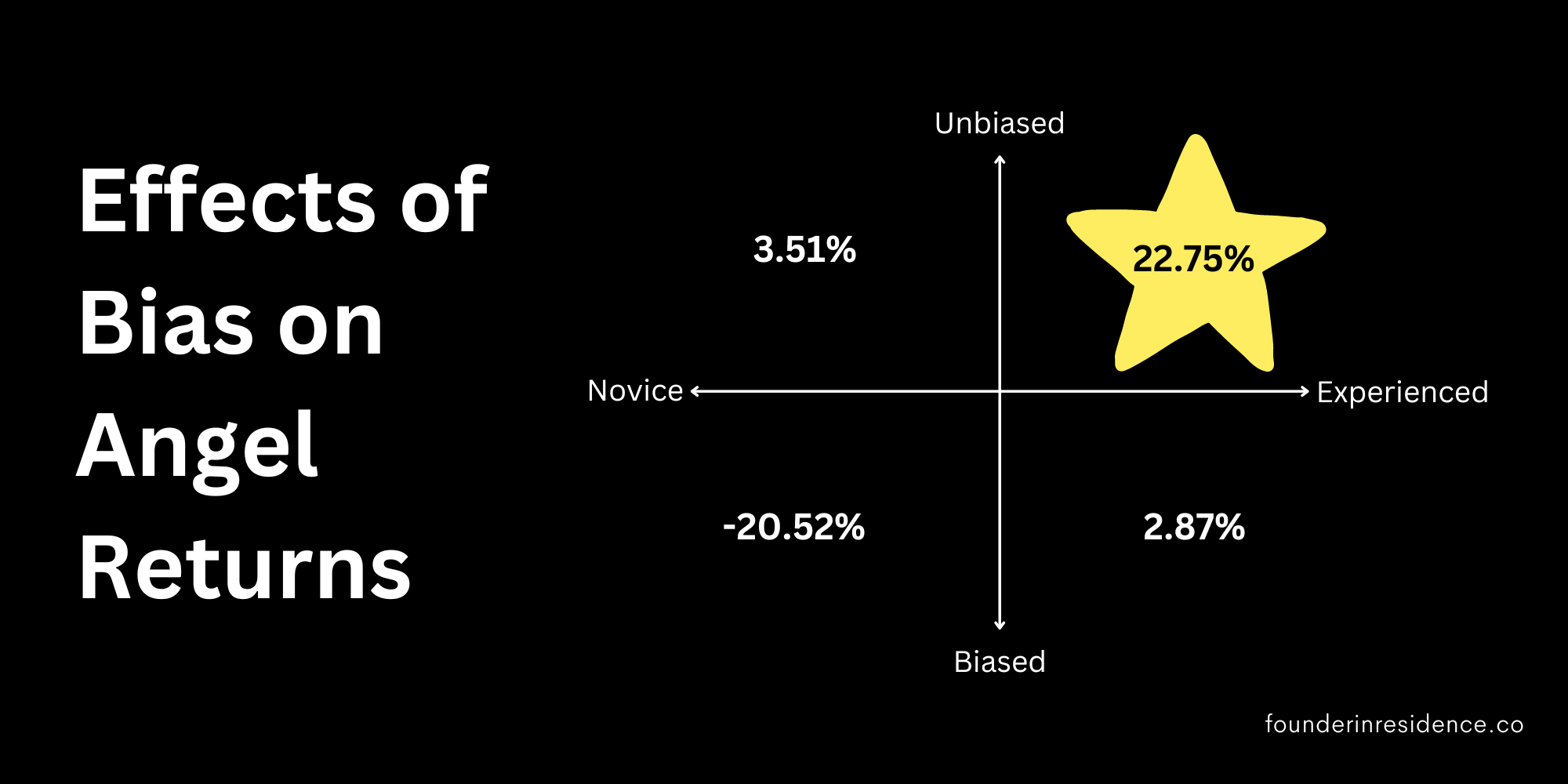
More experience as an Angel leads to greater returns. This makes sense. Angels with more than 10 deals outperformed novices in all cases.
But even those experienced Angels did not outperform the algorithm on average (7.26% IRR for the AI vs 2.87% for humans).
What moved the needle was when experienced Angels also had the fewest biases. I think the two are related: as an Angel sees more deals they instinctively course correct on biases that may lead to bad decisions. Or they should.
What is striking is how much greater the returns were: 22.75% for experienced, unbiased Angels vs -20.52% for inexperienced, biases Angels.
This supports my belief that removing bias doesn't have to be a moral or political issue, it can simply be driven by greed.
What founders can do about it
Founders do not have time to fixing investor bias. They have to focus on building their startups.
But given that these biases exist, there are some things founders can do:
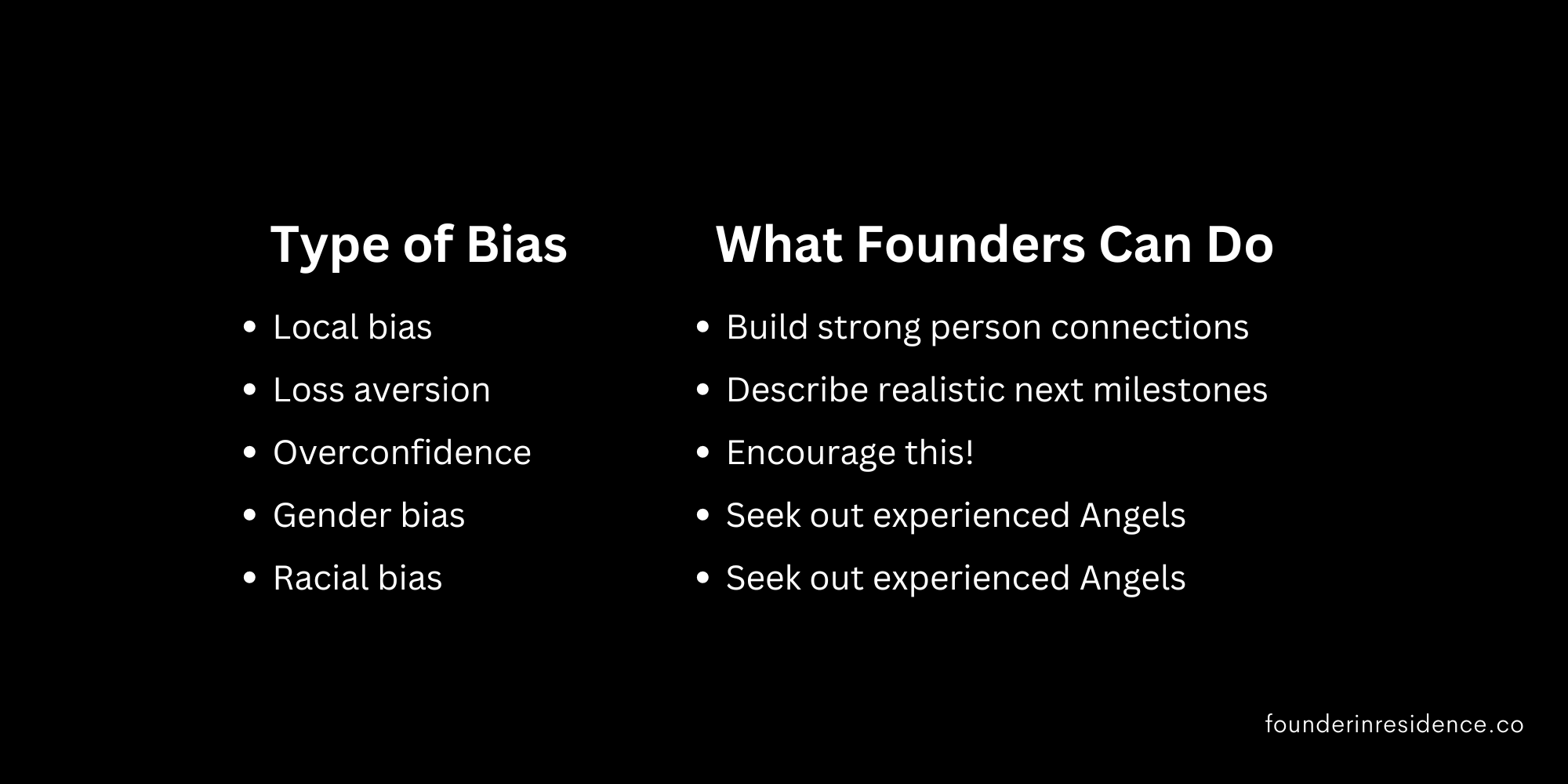
Local bias can work to a founder's advantage. They can meet Angels face to face and build strong personal connections. Their personal reputation and standing in the community can be a strong signal. Being the first to bring a certain type of company to the local market can be advantageous.
To counter loss aversion, founders should make sure they paint a realistic milestone that can be achieved, in addition to the big dream. Angels need to get excited by your vision but convinced that you can survive. Show them.
There's nothing wrong with founders taking advantage of Angel overconfidence. Lean into it by highlighting external validation and traction that shows positive momentum. As I said in before, most Angels are followers so make it easy for them to follow by emphasizing who else is in the deal.
On the topic of racial and gender bias, it seems that the most practical counter measure is to focus on pitching more experienced Angels as these people seem to be less susceptible to bias.
In addition, founders should do everything they can to build a funding track record. Leverage every funding program that targets under-represented founders, for example.
This was due to a lawsuit from the American Alliance for Equal Rights who claimed a race-specific program unfairly disadvantaged other races.
This is ridiculous. Bias is baked in to the system, even in the data that may train future investment algorithms. We need more targeted funding, not less.
Data is the culprit
Outside of the negative effects of bias, this discussion is yet another example of the sorry state of startup data. It sucks.
This experiment was done with a small number of Angels, a small number of deals, and in only one region. Because it's so difficult to get more people to share their data.
More and better data is the way we will eliminate bias.
Because hard numbers show that bias is losing strategy. Angels take note.


