

This is Part 2 of Storytelling is the Ultimate Hack. In Part 1, I wrote about how storytelling helps founders bridge the gap between their traction (i.e. the past/present) and their vision (the future). I also talked about how startups can use uncertainty to their advantage when they tell their stories.
In this article, I focus on the hidden layers and the unspoken cues that shape investors’ perception of your team, your progress, and your potential.
Wine signalling.
In “Price information influences the subjective experience of wine: A framed field experiment” researchers at the University of Basel studied how price influenced the taste of wine.
We all know the situation of being invited to a dinner party and wanting to impress the hosts. It's time to pick up an expensive bottle of wine. But most people, including the hosts, are not wine experts. So you either have to explain how much the bottle costs or ‘accidentally’ leave the price tag on, both of which are gauche.
There is no shortage of research on how price influences consumer perception of quality. But in this study, researchers focused on how price signals altered a wine’s taste. They deceptively labelled lower quality wine as more expensive and then compared with blind tasting of unlabelled wine.
They found that when given an artificially higher price, poor quality wine actually tasted better. If participants were allowed to take home bad-but-expensive wine, I’m sure they would have been able to describe all the ways this wine was pleasing to their palate.
Changing how wine tastes using price is just one example of the power of signalling.
Learn from luxury.
Look at this image: a model standing in an arena next to a horse, wearing a pair of shoes.

Now ask yourself: How much do the shoes cost? Are they high or low quality? What type of person would buy these shoes and where would they be sold?
There’s a good chance your answers would point to luxury and quality, indicating a high-end price point. And you probably didn’t even look all that closely at the shoes.
Now let’s remove the model and the product.

All that’s left is a horse and an arena. How much has your perception changed?
Probably not by much.
The imagery still signals something expensive, luxurious and exclusive. Not everyone can afford a horse, much less an arena.
This is exactly how luxury brands operate. They don’t sell tangible attributes. They sell signals: status, scarcity, and belonging to an elite group.
Startups can learn from how luxury brands do storytelling. Selling luxury is not about communicating what something does, but what it represents.
Startups can use the same approach. Selling a story based on your product specs never works. Try removing all of your bullet points and screenshots. What’s left are the intangible signals that tell your audience what your solution represents and why it matters.
Disclosure: these images are from an ad campaign I worked on for Zvelle, a luxury shoe brand founded by my wife.
How to Pair signals with your core message.
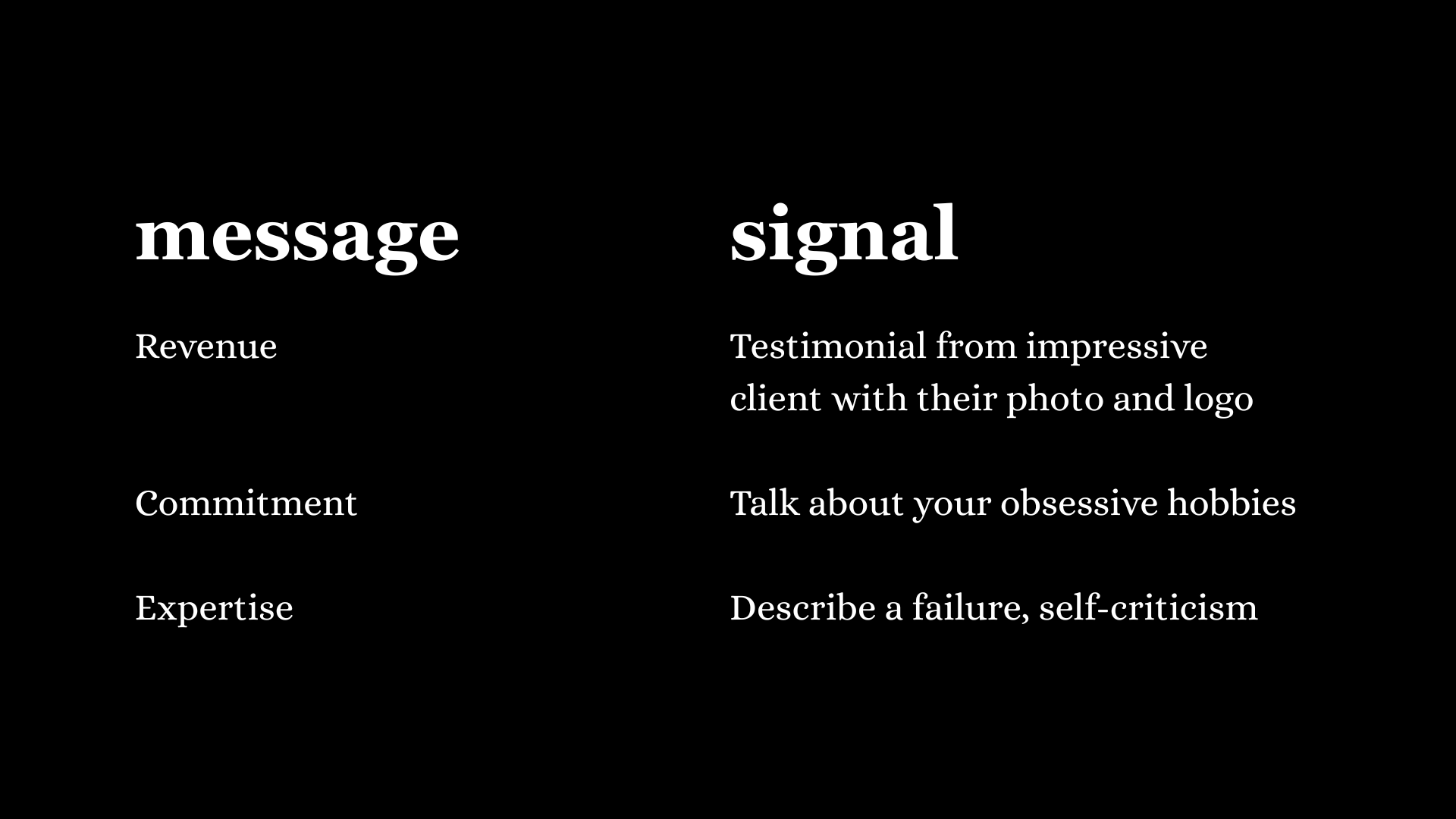
Here are a few examples of matching signals and core messages in your story:
Revenue
Investors hear the same ARR numbers every day, some even better than yours. But they’re just numbers. Add meaning to those metrics by adding signals.
E.g., a testimonial, logo or photo from a well-known client. These signals enhance your message by showing you not only have achieved $1M ARR, for example, but you’ve done it with legitimate clients. Use signals to show the degree of difficulty of that revenue number you achieved.
Team
Every founder says they are passionate and dedicated. Those messages do not stand out.
Instead, talk about something outside of your startup that you’ve obsessively pursued. Your side hustles, marathon times, competitive bagpiping. Especially for first time founders, these are not just colorful anecdotes but strong signals that you have grit, patience and perseverance.
If you think startups are hard, try piping.
Expertise
You don’t convince someone you’re an expert by acting like you know everything. Overconfidence signals inexperience. Real expertise gives you a more grounded confidence that includes the possibility of failure and the presence of uncertainty.
To exude expertise, talk about insights gained from past failures. Be open about the limits of your knowledge or what is still to be learned. This honesty doesn’t show weakness, it signals self-awareness and the desire to learn. A true expert knows what they don't know.
Beware contradictory signals.
There are many ways to signal what you want to say: words, imagery, product names, price, reputation and more. There is a measurable, behavioral basis to signalling, but it is not an exact science. You need to experiment.
A good place to start is to make sure you are not saying one thing (e.g., high quality) and signalling the opposite (low price, imagery that includes everyone). Clean up your signals or they'll work against you.
If you've used signals in your storytelling share what's worked or what hasn't in the comments.
In Part 3, I’ll explore techniques for focusing attention and elevating the importance of your core messages.


