

Whenever I teach my Storytelling for Startups workshop the topic of feedback comes up. Getting feedback is where the plan meets the battlefield. Some feedback is crucial because it helps you hone and improve your story (and your startup). Other feedback is confusing, inconsistent or, if you’ve been ghosted, non-existent.
How do you tell which is which?
This post is about helping to decode the five most common types of feedback after you pitch.
But first...
Investors do not owe you clear feedback.
It would be helpful if you could take whatever an investor said at face value (and helpful if they were right). You could take the average of all feedback and have a clear picture of where your story fell short.
But investors are not always right and they do not always give you a straight answer.
In fairness, it’s not the job of an investor to give you a detailed critique of your pitch. If someone does, that’s generous. Appreciate them.
You are not objective.
How are you contributing to your own confusion?
Most founders are not great at interpreting feedback. That’s not a sign they aren’t great founders. I’m suspicious when a founder is too coachable.
People expect founders to be Zen-like vessel of pure rationality but in the real world, anything that’s not a yes brings up negative emotions. Anger, frustrating, disappointment, even shame at feeling they were not prepared enough.
Just remember that you are fundraising, not feedback-raising.
There are diminishing returns to trying to spend too much time converting a no to a yes. Try a little. But then move on.
Are you pitching the right investor?
One more thing. Pitch the wrong investor and you’ll get wrong feedback. This happens a lot. Eg when pre-seed companies pitch late stage funds. Or when not enough time is spent asking yourself why this particular investor would want to invest in you.
If you do not have a detailed and specific reason why you think an investor would invest in you, you’re spraying and praying.
Five types of feedback
#1 You're too early.

This is one of the most common ways VCs politely say no to you. If this is the only feedback you got, then move on.
If they provide specific ARR hurdles or other metrics, then you probably are too early. Save them for later.
But if you are getting this feedback consistently it often does not mean you're actually too early. It means the investor is not impressed by what you've achieved.
Almost all VCs invest in pre-revenue and even pre-product companies. But in every case there are one or two things that knock their socks off. That could be an audacious vision, a standout team, a really cool technology or all of the above.
"Bad early" means you just haven't achieved enough.
"Good early" means you've achieved something special that points to a bright future.
#2: Your market is too small

When a VC says "your TAM is too small" or it's not a billion dollar market, they're saying they don't see how a huge unicorn can be born in this market.
Sure it's often theory-crafting but it's an easy way to let a founder down.
It's time to move on if you don't get any detailed questions about your market.
But if you do, and it's a little uncomfortable because you didn't consider different market segments or how markets are changing, take notes and learn.
In my experience, a startup's market will always seem small if I don't really believe the problem is severe and the solution is really special. Because if I truly feel the pain of the problem, and I like the solution, I'll can easily convince myself there's a big market for this somewhere.
#3: You don't have a moat

Many founders make the mistake of listing patents and other forms of IP protection when asked about a moat. Then it's super confusing when investors still say your moat isn't big enough.
What's missing is not a list of patents or incremental defences like a lower price or a bigger feature set. It's having a strong opinion at the core of your startup that most people would disagree with.
What was AirBnB's moat at the beginning? They didn't patent couch surfing.
Their moat was the fact that almost everyone thought it was a bad idea. Instead of being afraid of this feedback, you should aim to do something innovative enough that most people think it will never work. That is a deep and wide moat, at least at the beginning.
#4: You can't make money

This is another area of heavy theory-crafting among investors.
Unless they ask specific, tough questions at a granular level of detail about your pricing, margins, channels etc. That probably indicates you have more to learn about your go to market, unit economics etc.
But does this really apply to seed-stage companies?
If you're getting a lot of pushback on your business model it's probably a sign that your financial storytelling is not good. A spreadsheet does not replace a story.
A clear and convincing story about how you grow shows you haven't forgotten to think about big categories of costs like distribution. It shows you have a sophisticated view of your financial engine, even if neither you nor the investor really knows what's going to happen.
 Raymond Luk
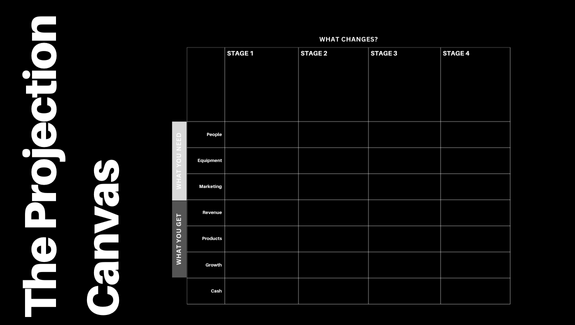
I talked about financial storytelling in The Projection Canvas
#5: We don't believe the team.

When an investor loves your space, is impressed by your traction and is generally positive, the fact they passed on the deal may be an unspoken concern about your team.
You'll rarely if ever get this feedback directly because VCs are human beings. No one likes telling a founder their idea is great but the team sucks.
What you can do about it is to make sure you are not underselling your team when you pitch. Don't wait until your Team slide to infuse your pitch with your founding team's contributions. Mention key contributors throughout your story.
When it comes to talking about your team talk about yourselves like the Avengers. What are your superpowers that, combined, make you an unstoppable force and the only ones who can build this vision?
It can't all be bluster. You have to have substance. But one way to quiet worries about your ability to scale a huge company is to exude confidence right from the start.
It's not easy to hunt for unicorns.
This post has been for the founder who wants to extract as much signal as possible from the noise of feedback. After all this you may still feel that investor feedback is unnecessarily confusing.
But keep in mind one thing.
While you’re trying to decode VC feedback they are trying to decode you.
They’re trying to figure out which signals that you’re giving off are true and which are false. Which things will change. And how you will react to those changes.
They’re probably just as confused as you are.


